Tell us about the job
Takes about a minute. No obligation.
A contractor quoting heat pump repair in Passaic County has to establish how much of what they find is fatigue and how much is a discrete fault worth fixing. Homes in Passaic County, NJ run heat about eight months a year, from October through May. The refrigerant circuit, the reversing valve, and the defrost controls all carry the load of that heating season, and each of them shows a different failure signature depending on whether it was undersized, poorly charged, or just worn through regular cycling. Capacity that drops off late in the heating season is not always a refrigerant leak; it can be a reversing valve that is slow to seat or a defrost cycle that is running too often. A contractor who skips the operating history and goes straight to parts is pricing the wrong repair.
Ductwork that has carried several generations of equipment accumulates problems that only show up once a technician is inside the system: failed seals at trunk joints, insulation that has compressed or separated, flex runs that were added for a previous unit and sized wrong for this one. Half the homes in Passaic County, New Jersey were built in 1956 or earlier (2020-2024 ACS 5-year). That history matters for heat pump repair specifically because a heat pump moves refrigerant and air in both directions across seasons, and a duct system with slow leaks or collapsed sections loads the components that are already failing. What a contractor finds in the air handler is shaped by what the ducts have been doing to it.
The Parts of a Heat Pump a Contractor Checks First
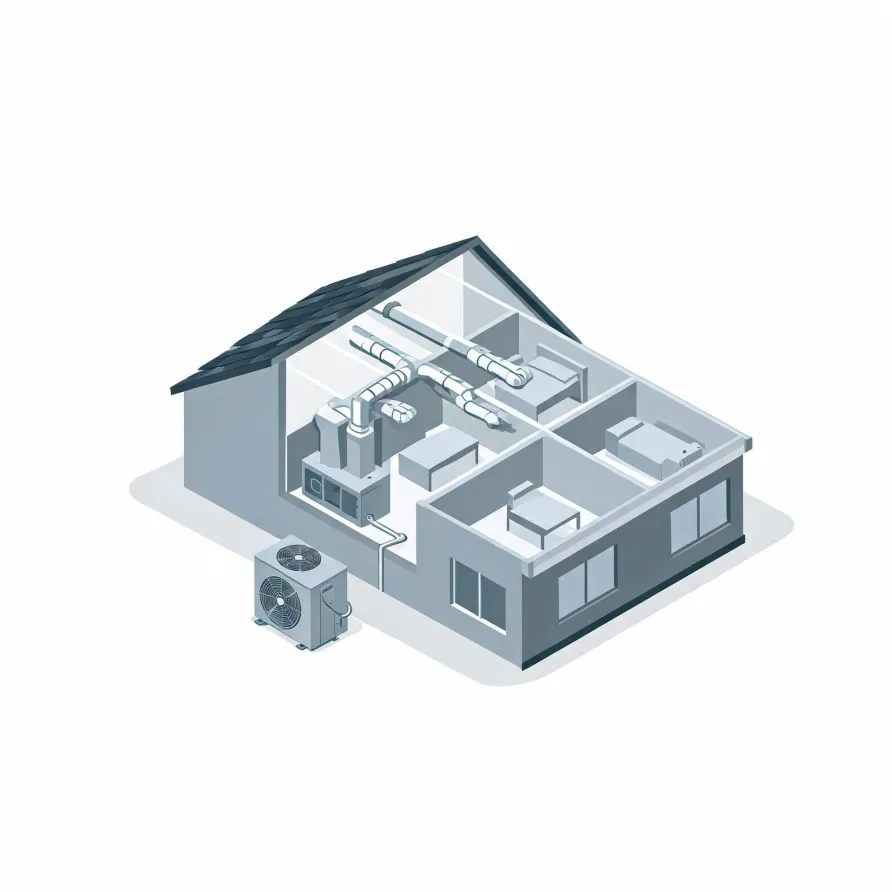
The outdoor unit is the piece most homeowners recognize: a metal cabinet that sits on a pad beside the house and holds the compressor and the outdoor coil. The compressor is where most repair calls begin. When it runs poorly or not at all, the whole system feels it. The outdoor coil pulls heat from the air, and a bent or dirty coil can starve the system before anything else fails.
Inside the house, the air handler contains the indoor coil and the blower that moves conditioned air through your home. The reversing valve, which lives in the outdoor unit, is what lets a heat pump shift between heating and cooling, and a fault there produces symptoms that can look like several other problems at once. The refrigerant lines connecting the two units are also on a contractor's checklist, since a slow leak changes how every other component behaves.
The drawing shows a typical heat pump layout, and a licensed contractor determines which parts apply and what needs attention in your specific home.
Get matched in Passaic CountyPassaic County, by the numbers
80 severe weather events were recorded in Passaic County, New Jersey between 2015 and 2024.
NOAA National Centers for Environmental Information, Storm Events Database, bulk CSV export, events 2015-01-01 through 2024-12-31.Half the homes in Passaic County, New Jersey were built in 1956 or earlier (2020-2024 ACS 5-year).
U.S. Census Bureau, 2020-2024 American Community Survey 5-Year EstimatesPassaic County, New Jersey holds 185,816 housing units (2020-2024 ACS 5-year).
U.S. Census Bureau, 2020-2024 American Community Survey 5-Year EstimatesOwners occupy 53.1% of the occupied homes in Passaic County, New Jersey (2020-2024 ACS 5-year).
U.S. Census Bureau, 2020-2024 American Community Survey 5-Year EstimatesRules & Standards Governing Heat Pump Repair in Passaic County, New Jersey2 sourced rules & standards
Licensing Rules for HVAC Repair in Passaic County, New Jersey
In New Jersey the HVACR licence is the State's alone: a municipality, local board of health or any other agency may not issue or renew a Master HVACR contractor's licence.
New Jersey requires a Master HVACR contractor licence: no person or business may engage in the business of HVACR contracting, or advertise as a Master HVACR contractor, without being authorised under the State HVACR Contracting License Law.
Weather Stress on HVAC Equipment in Passaic County
Heat pumps work against outdoor conditions every time they run, and how hard they work depends on what the weather here actually does. The chart below tracks recorded severe weather events in the county, because local weather history is part of what shapes repair frequency and equipment wear.
80 severe weather events, 2015–2024. Source: NOAA National Centers for Environmental Information, Storm Events Database.