Tell us about the job
Takes about a minute. No obligation.
A contractor diagnosing a heat pump in Sussex County starts by accounting for what the heating cycle has already put on the equipment. Homes in Sussex County, NJ run heat about eight months a year, from October through May. Cold air forces a heat pump to work harder for the same output, and the compressor, the reversing valve, and the defrost controls carry the heaviest share of that load. By the time a system fails, those parts have cycled through a long sequence of cold starts and sustained runs. A contractor checking refrigerant pressure, valve function, and compressor draw is reading that accumulated wear directly, and what they find decides whether the repair is a single component or a broader rebuild.
Much of the housing in this county was fitted for heat pump equipment after the structure was already built around something else. Half the homes in Sussex County, New Jersey were built in 1973 or earlier (2020-2024 ACS 5-year). That gap between construction and the systems that followed it means the ductwork a contractor works around carries the history of whatever ran before, but the heat pump itself is the readable thing. When a repair call comes in, what the opened unit shows, worn contacts, refrigerant charge, compressor draw, decides the scope and the parts list. Those components are specific to that system and that site, and they are what the contractor prices.
The Parts of a Heat Pump a Contractor Checks First
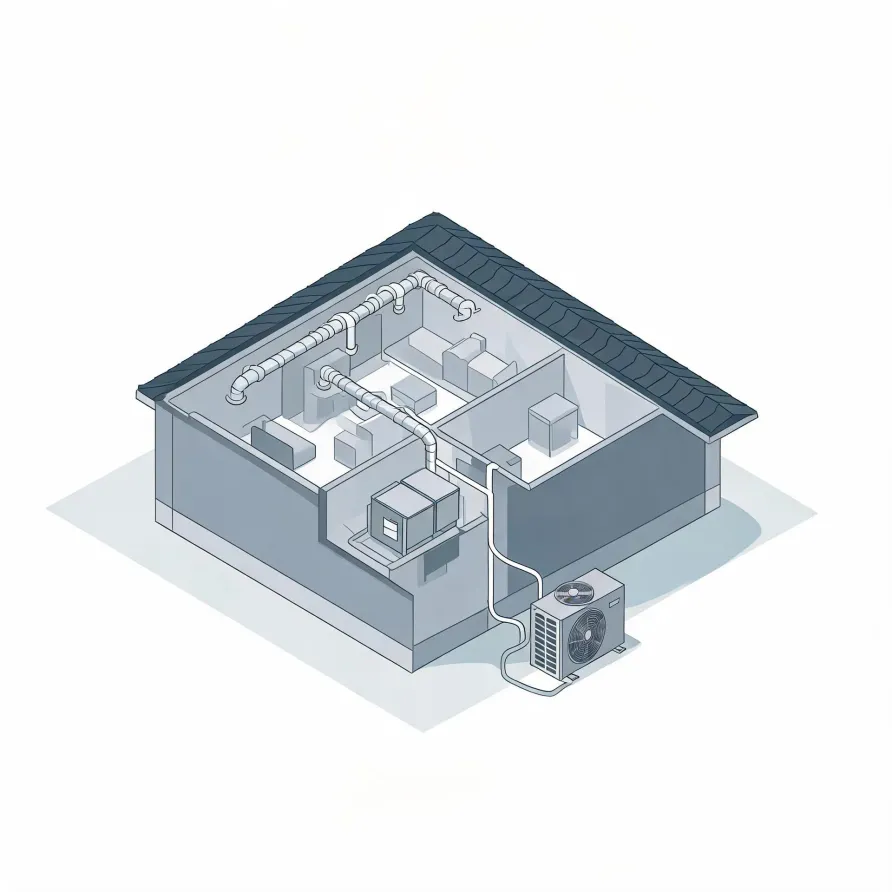
The outdoor unit is where most repair calls begin. It houses the compressor, which does the hardest work in the system, and the coil that sheds or pulls heat depending on the season. When either one is failing, the system struggles to hold temperature or stops moving conditioned air altogether.
Inside the house, the air handler holds the indoor coil and the blower that pushes air through the home. The refrigerant lines run between the two units, and the reversing valve inside the outdoor cabinet is what lets the system switch between heating and cooling. A stuck or leaking valve shows up as a system that works in one mode but not the other.
The drawing shows a typical layout, and a licensed contractor determines which parts apply to your specific setup.
Get matched in Sussex CountySussex County, by the numbers
197 severe weather events were recorded in Sussex County, New Jersey between 2015 and 2024.
NOAA National Centers for Environmental Information, Storm Events Database, bulk CSV export, events 2015-01-01 through 2024-12-31.Half the homes in Sussex County, New Jersey were built in 1973 or earlier (2020-2024 ACS 5-year).
U.S. Census Bureau, 2020-2024 American Community Survey 5-Year EstimatesSussex County, New Jersey holds 62,865 housing units (2020-2024 ACS 5-year).
U.S. Census Bureau, 2020-2024 American Community Survey 5-Year EstimatesOwners occupy 83.7% of the occupied homes in Sussex County, New Jersey (2020-2024 ACS 5-year).
U.S. Census Bureau, 2020-2024 American Community Survey 5-Year EstimatesCodes & Standards Governing Heat Pump Repair in Sussex County, New Jersey2 sourced rules & standards
What Sussex County and New Jersey Require for HVAC Repair
In New Jersey the HVACR licence is the State's alone: a municipality, local board of health or any other agency may not issue or renew a Master HVACR contractor's licence.
New Jersey requires a Master HVACR contractor licence: no person or business may engage in the business of HVACR contracting, or advertise as a Master HVACR contractor, without being authorised under the State HVACR Contracting License Law.
Severe Weather Events in Sussex County, NJ
Extreme weather puts heat pumps under sustained stress, and Sussex County's climate is the operating condition every local system is built around. How hard a unit has had to work, and how often, shapes what repairs it needs and when.
197 severe weather events, 2015–2024. Source: NOAA National Centers for Environmental Information, Storm Events Database.