Tell us about the job
Takes about a minute. No obligation.
A heat pump in this area runs both directions: it pulls heat in during winter and pushes it out during summer, which means the compressor and reversing valve cycle through far more demands than a single-mode system ever does. Homes in Hudson County, NJ run heat about seven months a year, from October through April. The refrigerant circuit never gets a long idle stretch to sit quiet between seasons. Contractors diagnosing a failed heat pump here look at the reversing valve early, because it switches direction on every mode change and accumulates wear accordingly. A compressor that is borderline will show it sooner in a climate that asks for heating and cooling in the same unit.
Heat pump repairs in Hudson County turn on what the opened system actually contains and whether the manufacturer still makes what it takes. Half the homes in Hudson County, New Jersey were built in 1966 or earlier (2020-2024 ACS 5-year). A house that old has almost certainly gone through at least one equipment change, so the ductwork and the electrical have been worked around before. What a contractor finds inside the unit, worn contacts, failed reversing valves, refrigerant circuit damage, and whether current-production parts fit it, is what sets the scope and the price.
The Parts of a Heat Pump a Contractor Checks First
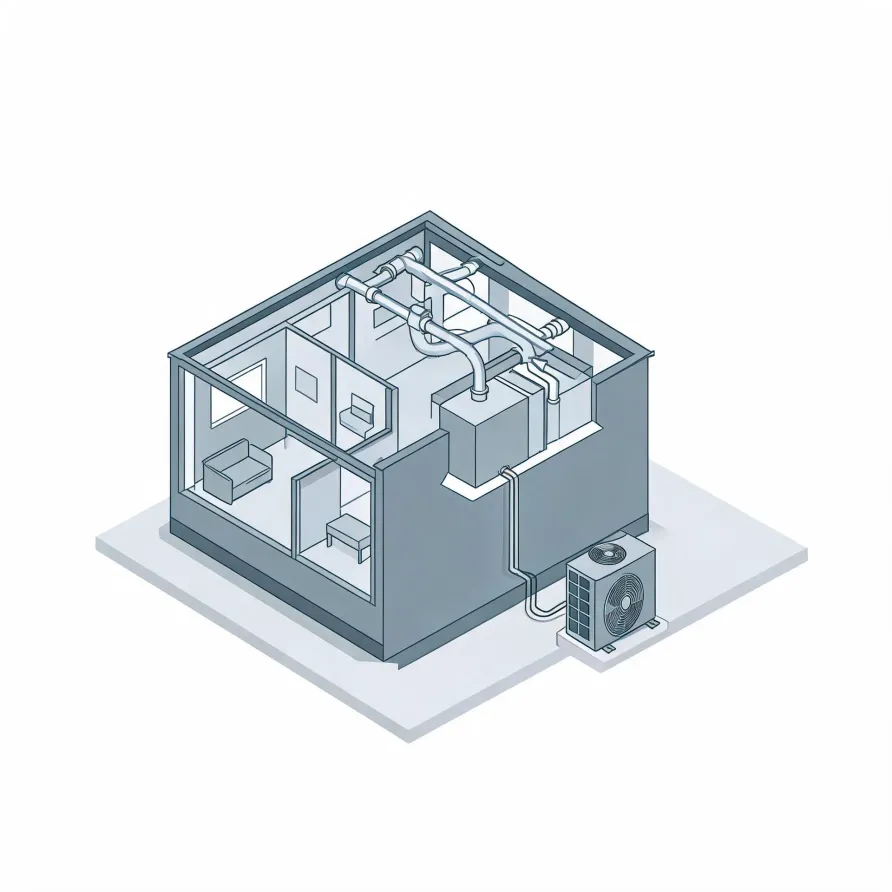
The outdoor unit sits outside the house and holds the compressor and the condenser coil. The compressor is the piece contractors reach for first when a heat pump stops doing its job, because a failing compressor shows up fast and clearly. The condenser coil wraps around the inside of that cabinet and is a common source of trouble when the unit has been running dirty or restricted.
The air handler lives inside, usually in a utility closet, basement, or attic, and it moves conditioned air through the house. It contains the evaporator coil and the blower motor, both of which a contractor will inspect closely. The refrigerant lines run between the two units and the reversing valve, which sits inside the outdoor cabinet, is what lets a heat pump shift between heating and cooling modes. When a system heats fine but will not cool, or the reverse, the reversing valve is where a contractor looks.
The drawing shows the general layout of a heat pump system, and a licensed contractor determines which components apply and what condition they are in at your specific house.
Get matched in Hudson CountyHudson County, by the numbers
52 severe weather events were recorded in Hudson County, New Jersey between 2015 and 2024.
NOAA National Centers for Environmental Information, Storm Events Database, bulk CSV export, events 2015-01-01 through 2024-12-31.Half the homes in Hudson County, New Jersey were built in 1966 or earlier (2020-2024 ACS 5-year).
U.S. Census Bureau, 2020-2024 American Community Survey 5-Year EstimatesHudson County, New Jersey holds 320,959 housing units (2020-2024 ACS 5-year).
U.S. Census Bureau, 2020-2024 American Community Survey 5-Year EstimatesOwners occupy 30.7% of the occupied homes in Hudson County, New Jersey (2020-2024 ACS 5-year).
U.S. Census Bureau, 2020-2024 American Community Survey 5-Year EstimatesCodes & Standards Governing Heat Pump Repair in Hudson County, New Jersey2 sourced rules & standards
Licensing and Legal Requirements in Hudson County, New Jersey
In New Jersey the HVACR licence is the State's alone: a municipality, local board of health or any other agency may not issue or renew a Master HVACR contractor's licence.
New Jersey requires a Master HVACR contractor licence: no person or business may engage in the business of HVACR contracting, or advertise as a Master HVACR contractor, without being authorised under the State HVACR Contracting License Law.
Severe Weather Events in Hudson County
Heat pumps work hardest when the weather outside is most demanding, and that steady stress over time is what drives repair needs. How often Hudson County sees severe weather is a local fact that shapes how hard the equipment in this area has to work.
52 severe weather events, 2015–2024. Source: NOAA National Centers for Environmental Information, Storm Events Database.