Tell us about the job
Takes about a minute. No obligation.
A heat pump working a Union County winter runs its compressor hard at the temperatures when refrigerant efficiency drops and the system struggles to extract heat from cold outdoor air. Homes in Union County, NJ run heat about seven months a year, from October through April. The reversing valve, the defrost board, and the compressor itself take the load during that stretch, and by the time a homeowner calls for a repair, those are the parts a contractor opens the unit to inspect first. Refrigerant charge and defrost cycle behavior tell more about what failed and why than the unit's age on paper does.
Ductwork put in for an earlier generation of equipment does not disappear when the equipment does. Half the homes in Union County, New Jersey were built in 1956 or earlier (2020-2024 ACS 5-year). A heat pump running through ducts sized and sealed for something else works harder than it should, and when it fails, the failure can look like a refrigerant problem or a compressor problem before a contractor finds a static pressure issue in the distribution. That distinction produces a different repair, a different scope, and a different bill.
The Parts of a Heat Pump a Contractor Checks First
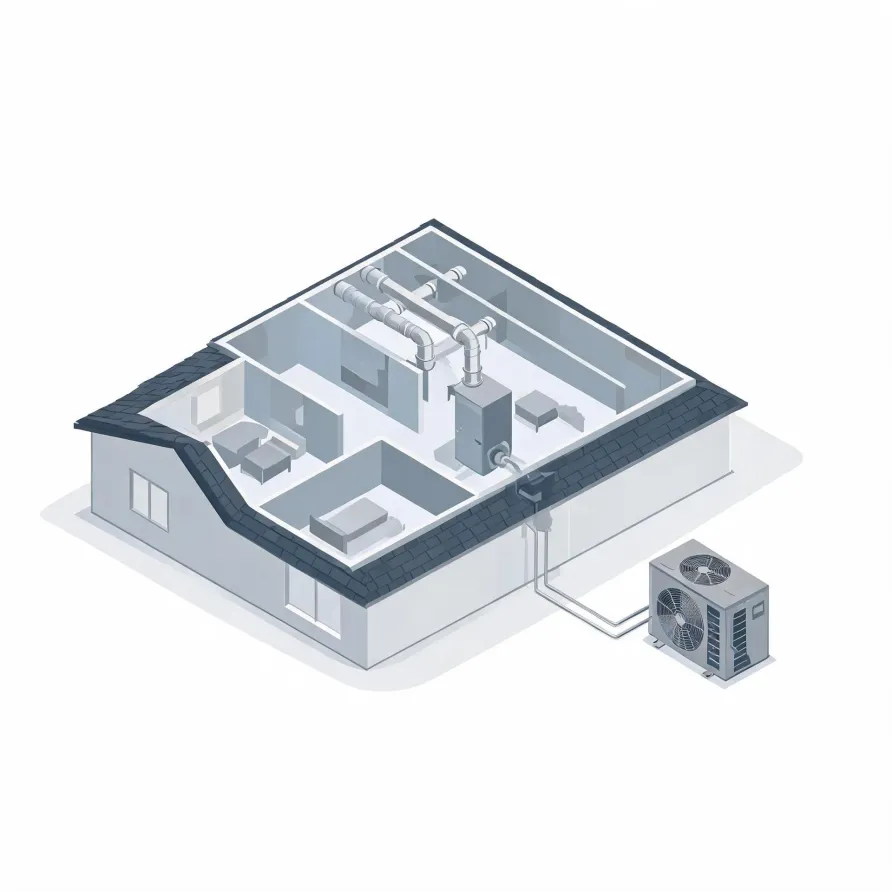
The outdoor unit sits on a pad beside the house and holds the compressor and the outdoor coil. The compressor is the part a contractor reaches first when a heat pump stops heating or cooling properly, because pressure and refrigerant faults show up there. The outdoor coil wraps around it and is where heat is absorbed or released, so a damaged or dirty coil changes how the whole system behaves.
The air handler lives inside the house, usually in a utility closet, attic, or basement, and it holds the indoor coil and the blower fan. The indoor coil pulls heat from the air or delivers it depending on the season, and the blower fan moves that conditioned air through the home. The reversing valve, which sits in the outdoor unit, is another common point of failure when a heat pump blows warm air in cooling mode or cold air in heating mode.
The drawing shows a general layout of these components, and a licensed contractor determines which parts apply and what condition they are in for your specific home.
Get matched in Union CountyUnion County, by the numbers
140 severe weather events were recorded in Union County, New Jersey between 2015 and 2024.
NOAA National Centers for Environmental Information, Storm Events Database, bulk CSV export, events 2015-01-01 through 2024-12-31.Half the homes in Union County, New Jersey were built in 1956 or earlier (2020-2024 ACS 5-year).
U.S. Census Bureau, 2020-2024 American Community Survey 5-Year EstimatesUnion County, New Jersey holds 212,385 housing units (2020-2024 ACS 5-year).
U.S. Census Bureau, 2020-2024 American Community Survey 5-Year EstimatesOwners occupy 57.4% of the occupied homes in Union County, New Jersey (2020-2024 ACS 5-year).
U.S. Census Bureau, 2020-2024 American Community Survey 5-Year EstimatesRules & Standards Governing Heat Pump Repair in Union County, New Jersey2 sourced rules & standards
What Union County, New Jersey Requires for HVAC Repair Work
In New Jersey the HVACR licence is the State's alone: a municipality, local board of health or any other agency may not issue or renew a Master HVACR contractor's licence.
New Jersey requires a Master HVACR contractor licence: no person or business may engage in the business of HVACR contracting, or advertise as a Master HVACR contractor, without being authorised under the State HVACR Contracting License Law.
Severe Weather Events in Union County
Outdoor conditions put real stress on heat pump components, and Union County's weather history shapes how hard local equipment has to work over time. Repair demand follows that workload, which makes the pattern below a relevant backdrop for any conversation about keeping a heat pump running here.
140 severe weather events, 2015–2024. Source: NOAA National Centers for Environmental Information, Storm Events Database.