Tell us about the job
Takes about a minute. No obligation.
Sizing a heat pump for this county starts with knowing how long the heating season actually runs. Homes in Cape May County, NJ run heat about seven months a year, from October through April. As outdoor temperatures drop through those months, a heat pump's capacity falls, and a unit that tests fine on a mild October afternoon may struggle through a February cold snap, leaning on electric resistance backup to make up the gap. A contractor quoting an installation here has to run a load calculation that accounts for that full cold stretch, not just the mild shoulder weeks, and has to establish whether the house has the panel capacity to support backup heat without tripping breakers on the hardest days.
Ductwork sized and routed for a gas furnace or central AC can carry air differently than a heat pump demands, and older stock in this county runs largely on those original layouts. Half the homes in Cape May County, New Jersey were built in 1981 or earlier (2020-2024 ACS 5-year). That puts the duct system, not the outdoor unit, at the center of what a contractor has to price and plan. A house where the ducts cannot move the right volumes, or where returns are too few, will underperform regardless of what gets mounted outside, and finding that out requires measurement, not assumption.
What Gets Installed With a New Heat Pump
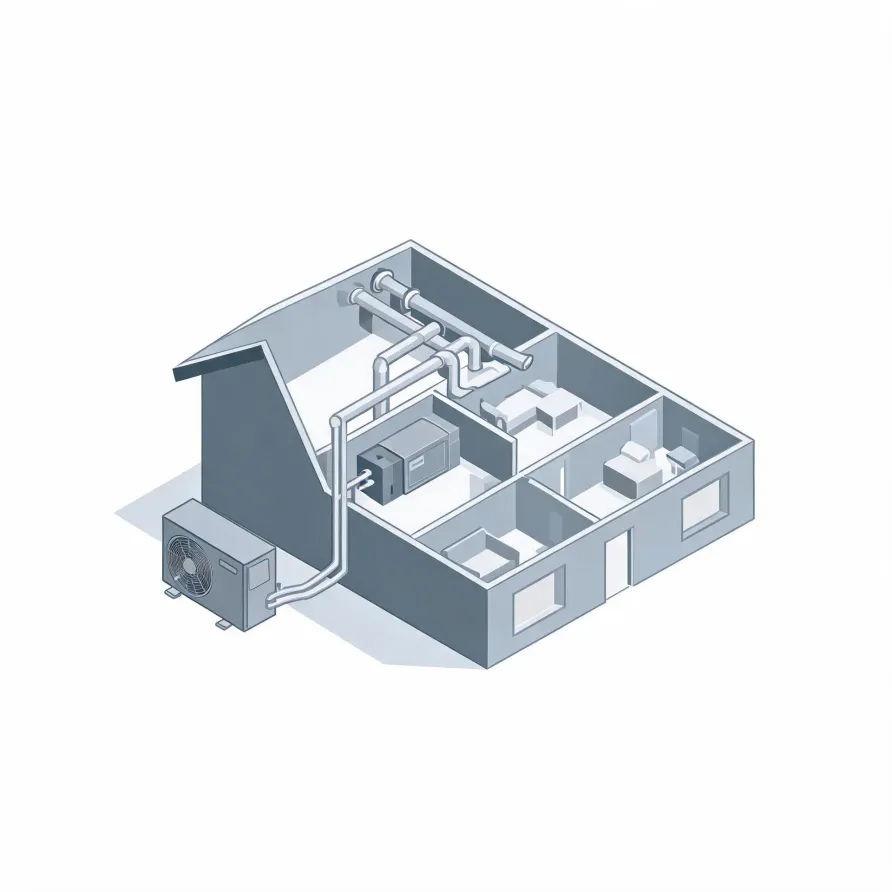
The outdoor unit is the piece most homeowners notice first. It sits on a pad beside the house and holds the compressor and the coil that move heat between the refrigerant and the outside air. Inside, the air handler mounts in a utility space, closet, or attic and pushes conditioned air through the home.
A refrigerant line set runs between the two units, carrying refrigerant back and forth through insulated copper tubing. The thermostat mounts on an interior wall and gives the homeowner control over the system, while the condensate drain line carries moisture from the air handler out of the living space.
The drawing beside this text shows a typical layout, and a licensed contractor determines exactly how each piece is positioned and connected in your home.
Get matched in Cape May CountyCape May County, by the numbers
133 severe weather events were recorded in Cape May County, New Jersey between 2015 and 2024.
NOAA National Centers for Environmental Information, Storm Events Database, bulk CSV export, events 2015-01-01 through 2024-12-31.Half the homes in Cape May County, New Jersey were built in 1981 or earlier (2020-2024 ACS 5-year).
U.S. Census Bureau, 2020-2024 American Community Survey 5-Year EstimatesCape May County, New Jersey holds 99,599 housing units (2020-2024 ACS 5-year).
U.S. Census Bureau, 2020-2024 American Community Survey 5-Year EstimatesOwners occupy 80.3% of the occupied homes in Cape May County, New Jersey (2020-2024 ACS 5-year).
U.S. Census Bureau, 2020-2024 American Community Survey 5-Year EstimatesRules and Standards Behind Heat Pump Installation in Cape May County, New Jersey2 sourced rules and standards
Licensing and Legal Requirements in Cape May County, New Jersey
In New Jersey the HVACR licence is the State's alone: a municipality, local board of health or any other agency may not issue or renew a Master HVACR contractor's licence.
New Jersey requires a Master HVACR contractor licence: no person or business may engage in the business of HVACR contracting, or advertise as a Master HVACR contractor, without being authorised under the State HVACR Contracting License Law.
Severe Weather Events in Cape May County
Heat pump performance is tied directly to what the climate asks of it year after year. Sizing and equipment selection for this part of New Jersey starts with understanding the real load the weather places on a system.
133 severe weather events, 2015–2024. Source: NOAA National Centers for Environmental Information, Storm Events Database.