
What defrost mode means on a New Jersey heat pump

Step 1 of 3: Equipment

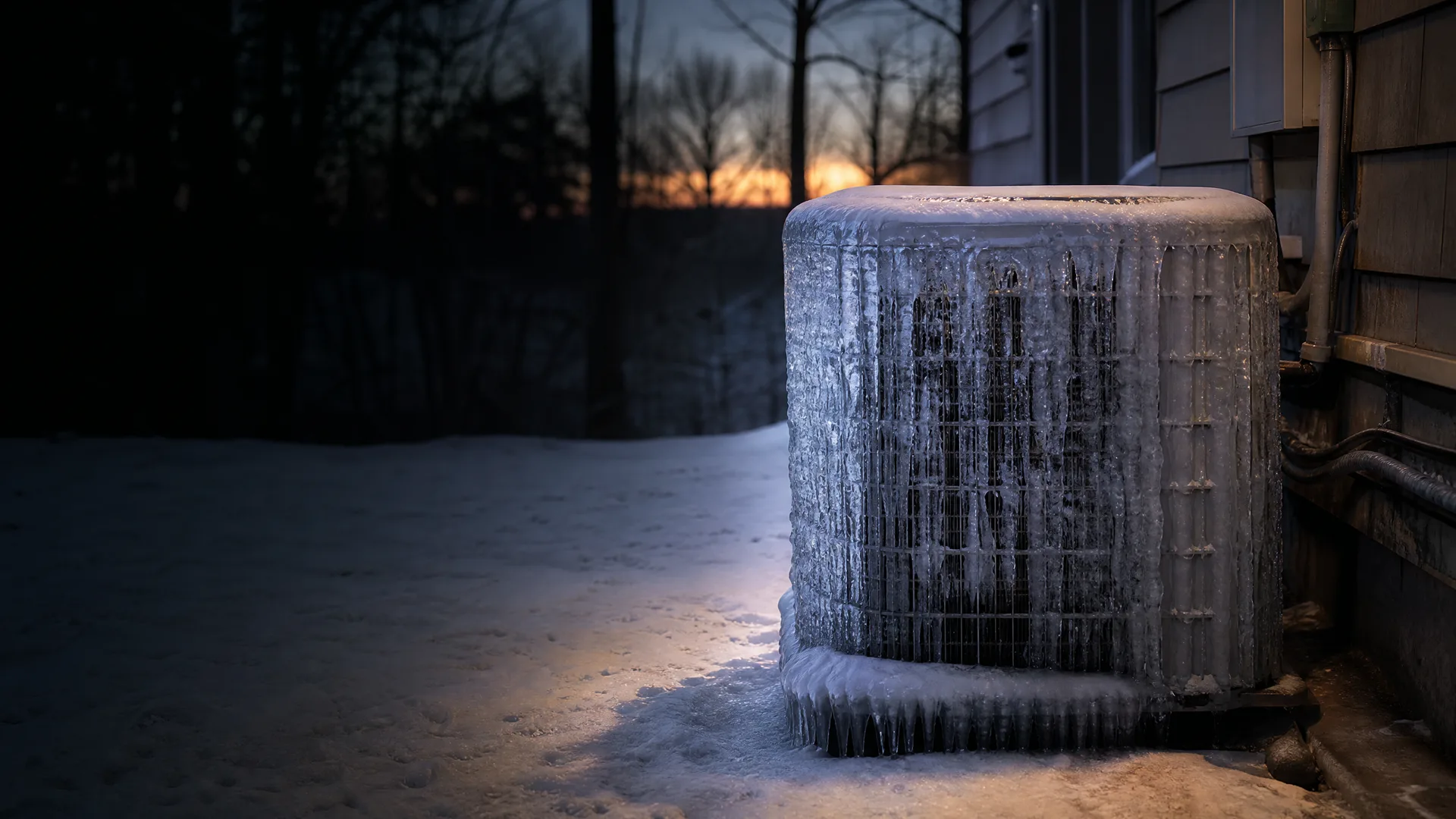
Defrost mode is your heat pump melting the frost off its outdoor coil. In New Jersey winters, that coil sits outside in damp, cold air, and frost builds up on it the same way it builds up on a car windshield overnight. When enough frost collects, the system reverses itself for a few minutes, sends warm refrigerant outside to melt it off, and you'll see steam rise from the unit. That's normal. During this time the outdoor fan usually stops and you may hear a change in sound as the system switches direction. If it's doing this every hour or two, or if the outdoor unit stays coated in ice afterward, something isn't cycling the way it should. That usually points to a stuck reversing valve, a failed defrost sensor, or a fan that isn't clearing the coil properly between cycles, and it's worth having someone look at it before the system has to work harder than it needs to in the cold.

An outdoor condenser unit encased in thick ice stands on snow beside a house with horizontal siding and exterior pipes, with bare trees and a sunset glow in the background.

Six in the morning, still dark, and you're out back before work with the dog. The outdoor unit is sitting there coated in ice, thick on the coil, a crust of it over the top panel. No fan noise, no hum, just cold quiet and your breath showing in the air. You stand there a second trying to remember if it looked like this yesterday. Inside, the house still feels warm enough, the thermostat hasn't complained, but seeing that much ice on a January morning in New Jersey makes you wonder if it's doing what it's supposed to or if something's stuck partway through.

Why does my heat pump blow cold air during defrost?

You went out and found the unit iced over, quiet, and now the air coming through your vents is cold instead of warm. It feels like something broke. You're standing there in a New Jersey winter wondering if you should shut the whole system off before it does more damage, or if this is just what it does.

It's running the AC backward to melt the ice, and the indoor fan is still moving air

A heat pump heats your house by reversing the same cycle it uses to cool it in summer. To clear frost off the outdoor coil, it flips into that cooling mode for a few minutes, which sends cold refrigerant outside to melt the ice. Some systems shut the indoor blower off during this, but plenty don't, and that's when you feel cool air at the vents instead of warm. It's not pulling heat from your house. Once the coil clears, the system reverses again and goes back to heating. If the air stays cold for more than ten or fifteen minutes, or the unit never comes back to heating on its own, that points to a stuck reversing valve or a defrost control that isn't ending the cycle.

A gray outdoor condenser unit on a concrete pad beside a white horizontal-siding house, with refrigerant lines and conduit running to a wall-mounted disconnect box, bare soil in front and a green shrub at left.

Running a normal cycle

This is what your outdoor unit should look like most of the time. The fins are clean, the fan is clear to turn, and refrigerant lines and wiring run neatly into the disconnect box. Air moves through the coil without resistance, so the unit pulls heat from outside and defrost only runs when frost actually calls for it.


An outdoor air conditioning condenser unit on a concrete pad beside a house with light horizontal siding and a concrete block foundation, with bare soil and small green plants around it.

Choked with buildup

Dust and grime have packed into the fins and grille here, the kind of coating that collects over a season near shrubs or a foundation bed. A coil that dirty holds frost longer once defrost kicks off, and it can struggle to shed it at all. That's when a contractor who knows this equipment needs to look at what's underneath.

A smiling bearded man in a dark green hooded jacket and blue t-shirt sits on a couch in a living room with shelves, a potted plant, and a bowl of popcorn on a wooden table.
A smiling man in a green long-sleeved shirt sits on a beige sofa in a living room, with a bowl of popcorn in the foreground, a large potted plant and shelving behind him.
A smiling man in a dark blue T-shirt sits on a couch in a dimly lit living room with a bowl of popcorn and a remote on a wooden table, a lit floor lamp and bookshelves behind him, and windows showing greenery.
A smiling bearded man in a dark green long-sleeved shirt sits on a leather couch in a living room, with a bowl of popcorn and a remote control on a wooden table in the foreground.
A two-story house with cream horizontal siding, a dark gabled roof, and a white front door, fronted by a lawn, shrubs, and a concrete walkway leading to a sidewalk and street, with large leafy trees on both sides.

New Jersey summer air carries a dew point around 63°F, averaged across June, July and August, according to NOAA climate data for the state. That's the number that tells you how heavy the air feels on top of the heat. Your heat pump has to pull that moisture out before it can cool the house, and the more water in the air, the longer the compressor runs to get there. You'll notice it as a system that seems to run and run without the house feeling any cooler, or air coming off the vents that's cool but still damp. If the coil is dirty or the charge is low, that moisture load is what pushes the system past what it can keep up with. Once you send in what's going on, you're not the one tracking down who can look at it. A local contractor who handles this equipment through the muggy months takes it from there.

NASA POWER T2MDEW county cells weighted by homes

Hand off the search today

Only one pro gets your request, so you hear from one company.

No charge to send it. You decide if you hire them.

A defrost cycle on a New Jersey heat pump usually runs somewhere around 5 to 15 minutes. During that stretch, the outdoor fan stops and a reversing valve sends hot refrigerant through the outdoor coil instead of the indoor one.

That's also why cold air comes through your vents for those few minutes. The system is heating the coil outside, not the air inside, and it switches back to normal heating as soon as the frost clears.

A weathered gray outdoor condenser unit on a concrete pad beside a house with horizontal vinyl siding, with conduit, refrigerant lines, and an electrical disconnect box on the wall behind it.
Before you get your heat pump repair
A gray outdoor condenser unit on a concrete pad beside a beige vinyl-sided house, with a wall-mounted disconnect box, flexible conduit, mulch bed, shrubs and a concrete walkway in front.
After you get your heat pump repair

Nothing about defrost is up to you or your thermostat. A sensor mounted on the outdoor coil watches the coil's temperature, and once it drops past a set point with enough frost built up, the system switches modes on its own. A reversing valve flips and pushes hot refrigerant backward through the outdoor coil instead of the indoor one, which is what actually melts the ice. The outdoor fan stops moving during this, since blowing cold air across the coil while it's trying to heat up would just work against it. Your indoor air might still feel warm because electric heat strips often kick in to cover for the system while it's busy defrosting outside. A second sensor is what ends the cycle, not a timer running out and not the ice being fully gone. If your unit is kicking into defrost every thirty minutes instead of every hour or two, that sensor or the reversing valve itself is likely the problem, not the cold snap outside.

What Triggers a Defrost Cycle

  • A sensor on the outdoor coil, or a timer board in some older units, is what actually triggers defrost, not a thermostat setting you control.
  • Once frost thickness or coil temperature crosses the built-in threshold, the reversing valve switches and sends hot refrigerant backward through the outdoor coil to melt it.
  • The outdoor fan shuts off during this process so the hot refrigerant isn't fighting cold air blowing across the coil at the same time.
  • Many systems bring on electric backup heat strips during defrost so the air coming out of your vents doesn't feel ice cold the whole time.
  • The cycle ends on its own once a second sensor confirms the coil has warmed past freezing, usually well before all visible ice is gone.
  • A heat pump that short-cycles into defrost every half hour instead of every hour or two is telling you the sensor or valve is failing, not that the weather is unusually bad.
A gray outdoor condenser unit on a concrete pad beside a house with horizontal lap siding, a conduit and disconnect box on the wall, a shrub with white flowers at right and evergreen foliage at left.
A clean coil like this moves heat fast, so defrost cycles stay short and the unit goes right back to warming your house.
An outdoor air conditioning condenser unit with a top fan grille sits on a concrete pad beside a house with horizontal siding and a concrete step.
Buildup like this makes the system call for defrost more often and stay stuck in it longer, leaving you with cold air and a bigger power bill.
  1. Outdoor coil temperature or frost thickness crosses its built-in trigger point

  2. The reversing valve switches, sending hot refrigerant to the outdoor coil

  3. The outdoor fan shuts off so heat stays on the coil instead of blowing away

  4. Indoor air handler keeps running, which is why vents blow cold for a few minutes

Power costs 22.48 cents per kilowatt-hour statewide

At 22.48 cents per kilowatt-hour, every extra minute your heat pump spends stuck in defrost shows up fast on your bill. A unit that's clean and running right clears the coil in a few minutes and gets back to heating your house. One that's struggling can sit there longer, pulling power without warming a single room.

EIA-861 2025 statewide residential average

What Defrost Mode Tells You

  • Defrost mode is your heat pump clearing frost off the outdoor coil, and it should end on its own within minutes.
  • A unit stuck in defrost too long is usually telling you the coil, fan, or sensor needs a look before the cold stretches your power bill further.
  • A contractor who services heat pumps in New Jersey all winter knows which of those parts tends to fail first on units your age.
  • Matching you with one licensed local contractor means one call back, not a string of them from companies you don't know.
  • Knowing what defrost mode is supposed to look like is the first step; getting the coil or sensor checked is the next one.

Defrost mode is normal. Your heat pump melts frost off the outdoor coil, then goes back to heating your house, and most of the time you never notice it happen. The trouble starts when that cycle runs long, or runs often, or the unit comes out of it still blowing cold air for more than a few minutes. That's not the system doing its job anymore. That's the coil, the fan, or the sensor that triggers the cycle telling you something's off, and it costs you every extra minute it sits there with power priced the way it is in New Jersey.

A sensor reading wrong, a fan that's slow to restart, a coil caked with buildup so it can't shed heat fast once the reversing valve switches back. Any one of those stretches a five minute cycle into something longer, and you feel it as cold air and a higher bill before you ever see the ice outside. A contractor who works on heat pumps through a New Jersey winter has seen which of those parts tends to go first on a unit like yours, because they're out checking this same complaint on someone else's coil the week before.

Getting matched means one contractor, local, licensed to do the work, not a handful of strangers calling back about the same ticket. You already know what defrost mode is supposed to look like. The next step is getting someone out to look at the coil or the sensor before this winter costs you more than it should.

A dark standing-seam metal roof with a stone chimney and metal cap, seen against a backdrop of autumn-colored forest and layered hills under an overcast sky.

Hand off the heat pump problem

Find a licensed pro

There's no charge for the request.

A heat pump stuck in a long defrost cycle burns power without putting much heat into your house. With New Jersey electric rates what they are, that adds up fast over a cold month. Getting the coil or sensor checked now is cheaper than paying for a system that keeps fighting ice all winter.