Tell us about the job
Takes about a minute. No obligation.
A heat pump in Mercer County works its hardest in the cold months, when outdoor temperatures drop and the system has to extract heat from air that resists giving it up. Homes in Mercer County, NJ run heat about seven months a year, from October through April. A contractor diagnosing a fault here checks the reversing valve and the compressor first, because those are the parts that cycle hardest through a long heating season. Capacity loss in cold air puts sustained strain on the compressor in ways that a summer-only cooling load does not. A repair quote that skips a full capacity check at low outdoor temperatures is leaving out the part of the season that does the most damage.
Ductwork installed for a furnace-and-central-air setup carries different pressures and tolerances than a heat pump demands, and in a county where so much of the housing was fitted out long before heat pumps were a residential option, that gap shows up once a contractor opens the system. Half the homes in Mercer County, New Jersey were built in 1969 or earlier (2020-2024 ACS 5-year). A refrigerant leak or a failing reversing valve is a straightforward parts question. What takes longer to answer is whether the air handler is seated in ductwork that can actually move the volume the repair restores, or whether the duct runs themselves are where the performance is going.
The Parts of a Heat Pump a Contractor Checks First
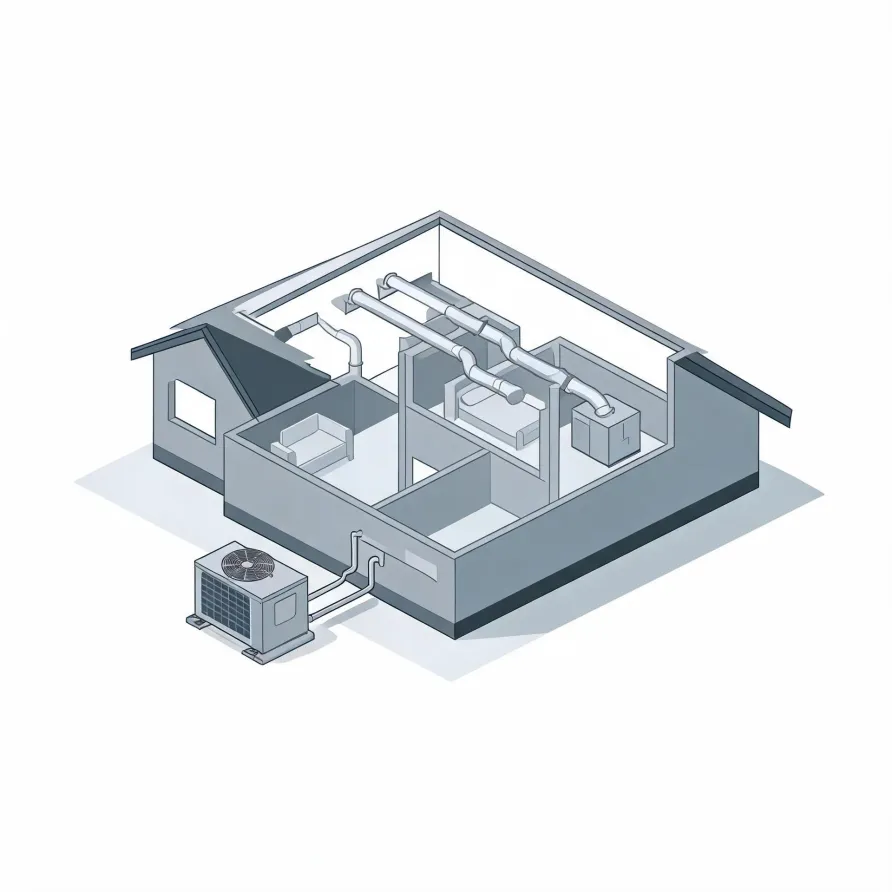
The outdoor unit is the piece most homeowners recognize first, sitting on a pad or bracket outside the house. It holds the compressor, which is where pressure changes happen, and the outdoor coil, which transfers heat to or from the outside air. When a heat pump stops cooling or heating, the compressor and that coil are among the first things a contractor examines.
Inside the house, the air handler moves conditioned air through the home and contains the indoor coil and the blower fan. A reversing valve, housed in the outdoor unit, tells the system which direction to work, and a contractor will check it when the system heats in one mode but not the other. The refrigerant lines running between the two units and the expansion valve are also on that checklist.
The drawing shows a representative layout of these components, and a licensed contractor determines which parts apply and what condition they are in for your specific home.
Get matched in Mercer CountyMercer County, by the numbers
159 severe weather events were recorded in Mercer County, New Jersey between 2015 and 2024.
NOAA National Centers for Environmental Information, Storm Events Database, bulk CSV export, events 2015-01-01 through 2024-12-31.Half the homes in Mercer County, New Jersey were built in 1969 or earlier (2020-2024 ACS 5-year).
U.S. Census Bureau, 2020-2024 American Community Survey 5-Year EstimatesMercer County, New Jersey holds 151,138 housing units (2020-2024 ACS 5-year).
U.S. Census Bureau, 2020-2024 American Community Survey 5-Year EstimatesOwners occupy 62.2% of the occupied homes in Mercer County, New Jersey (2020-2024 ACS 5-year).
U.S. Census Bureau, 2020-2024 American Community Survey 5-Year EstimatesCodes & Standards Governing Heat Pump Repair in Mercer County, New Jersey2 sourced rules & standards
Licensing Rules for HVAC Repair in Mercer County, New Jersey
In New Jersey the HVACR licence is the State's alone: a municipality, local board of health or any other agency may not issue or renew a Master HVACR contractor's licence.
New Jersey requires a Master HVACR contractor licence: no person or business may engage in the business of HVACR contracting, or advertise as a Master HVACR contractor, without being authorised under the State HVACR Contracting License Law.
Severe Weather Events in Mercer County
Extreme weather puts real stress on heat pump systems, which have to work harder and recover more often after significant weather events. How much of that load a unit carries depends on what the local climate actually delivers, and Mercer County has its own record.
159 severe weather events, 2015–2024. Source: NOAA National Centers for Environmental Information, Storm Events Database.