Tell us about the job
Takes about a minute. No obligation.
Sizing a heat pump for a Monmouth County house means accounting for conditions the equipment faces at the worst point of the season, not just the average of it. Homes in Monmouth County, NJ run heat about seven months a year, from October through April. As outdoor temperatures fall through those months, a heat pump pulls less heat from the air precisely when the house needs more of it. A contractor has to work out where that gap opens up and whether the backup heat source covers it, before a unit is ever selected. Get that calculation wrong and the system either short-cycles through mild stretches or runs the backup strip heat constantly through the cold ones, which shows up on the electric bill long before it shows up as a breakdown.
Ductwork laid out for a conventional forced-air system was sized around airflow patterns that heat pumps do not replicate, and what is in the walls of a Monmouth County house reflects exactly that. Half the homes in Monmouth County, New Jersey were built in 1975 or earlier (2020-2024 ACS 5-year). That history matters to a heat pump installation because the refrigerant-based delivery a heat pump uses moves air differently than what most of that ductwork was designed around. A contractor who inspects the existing runs before quoting can tell whether they will carry the new system without modification. Many will. Some will need rebalancing or new branch runs in specific rooms, and the electrical service gets the same check before any equipment is sized.
What Gets Installed With a New Heat Pump
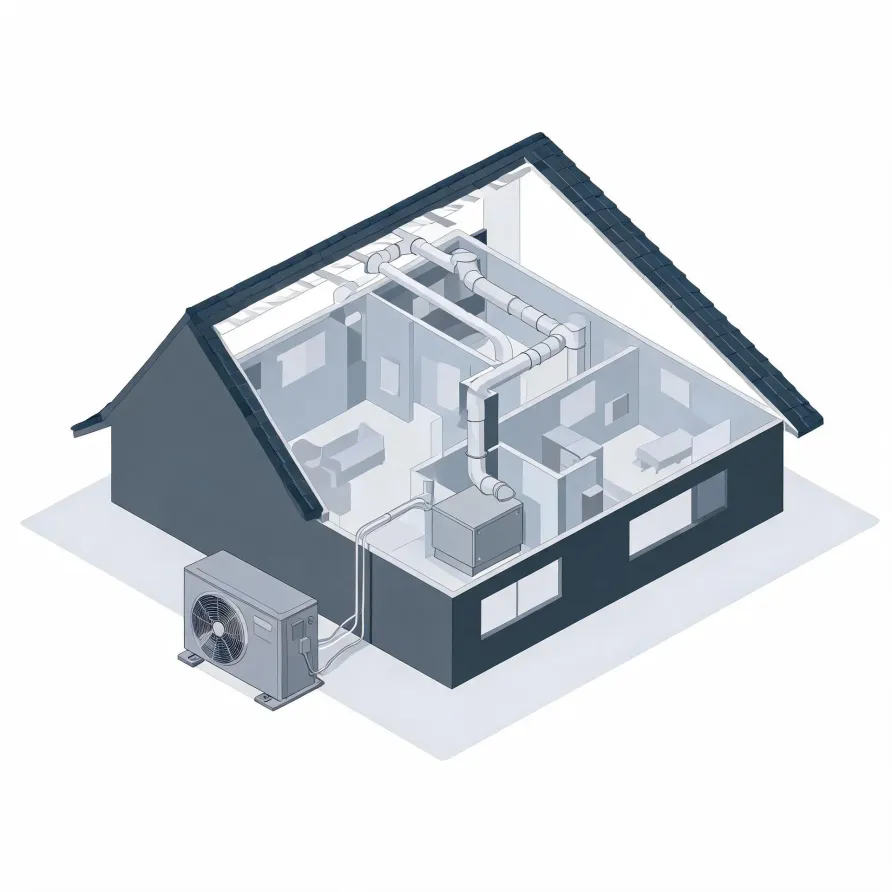
The outdoor unit is the piece a homeowner notices first. It sits on a pad beside the house and holds the compressor and the outdoor coil, which together do the heavy lifting of the system. Inside, the air handler mounts in a utility space, a closet, or an attic, and it is the unit that moves conditioned air into the living space.
A refrigerant line set runs between the two units, connecting the outdoor pad to wherever the air handler sits. A thermostat goes on an interior wall and gives the homeowner control over the whole system. The condensate drain line runs from the air handler to a safe discharge point, carrying away moisture the indoor coil pulls from the air.
The drawing shows the general layout of these components, and a licensed contractor determines exactly what applies to your house.
Get matched in Monmouth CountyMonmouth County, by the numbers
326 severe weather events were recorded in Monmouth County, New Jersey between 2015 and 2024.
NOAA National Centers for Environmental Information, Storm Events Database, bulk CSV export, events 2015-01-01 through 2024-12-31.Half the homes in Monmouth County, New Jersey were built in 1975 or earlier (2020-2024 ACS 5-year).
U.S. Census Bureau, 2020-2024 American Community Survey 5-Year EstimatesMonmouth County, New Jersey holds 270,415 housing units (2020-2024 ACS 5-year).
U.S. Census Bureau, 2020-2024 American Community Survey 5-Year EstimatesOwners occupy 75.6% of the occupied homes in Monmouth County, New Jersey (2020-2024 ACS 5-year).
U.S. Census Bureau, 2020-2024 American Community Survey 5-Year EstimatesHeat Pump Installation Rules for Monmouth County, New Jersey2 codes, standards, and regulations
Licensing and Legal Requirements in Monmouth County, New Jersey
In New Jersey the HVACR licence is the State's alone: a municipality, local board of health or any other agency may not issue or renew a Master HVACR contractor's licence.
New Jersey requires a Master HVACR contractor licence: no person or business may engage in the business of HVACR contracting, or advertise as a Master HVACR contractor, without being authorised under the State HVACR Contracting License Law.
Weather Load in Monmouth County
Heat pumps are sized and selected for the climate they run in, and climate here means more than average temperatures. Recorded weather events shape how hard the equipment works and how long it lasts, which makes this a question of local conditions.
326 severe weather events, 2015–2024. Source: NOAA National Centers for Environmental Information, Storm Events Database.